What it feels like
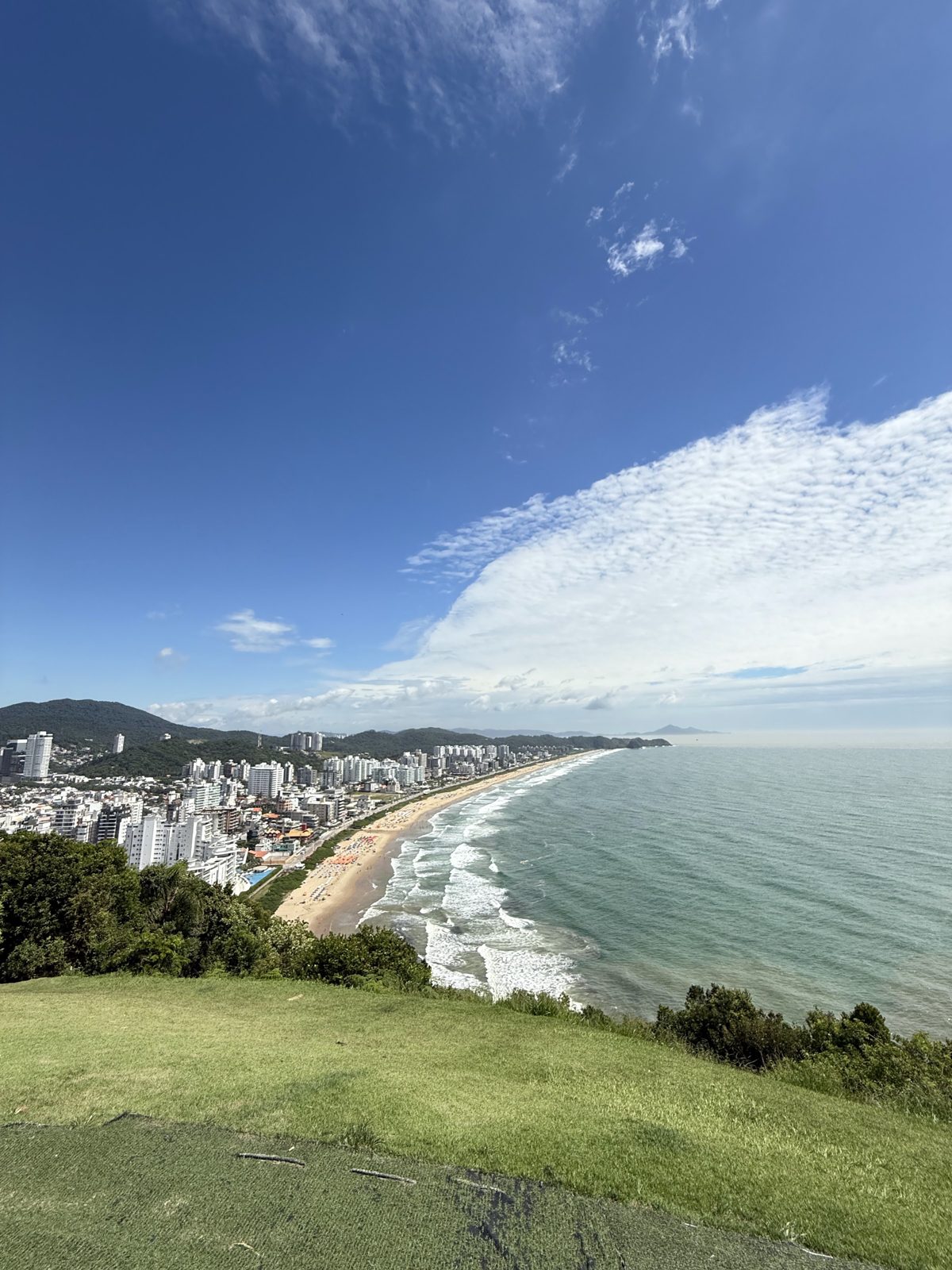
If BC feels like too much, Praia dos Amores is the first alternative. It sits just over the Morro do Careca hill from Pontal Norte, a few minutes from Centro.
It is much less dense. Most buildings here are only three to six storeys high, with trees and green hills behind.
It feels a little like the condo communities outside Miami. Maybe a little less interesting if you like to walk around a lot.
Where it is and how it connects
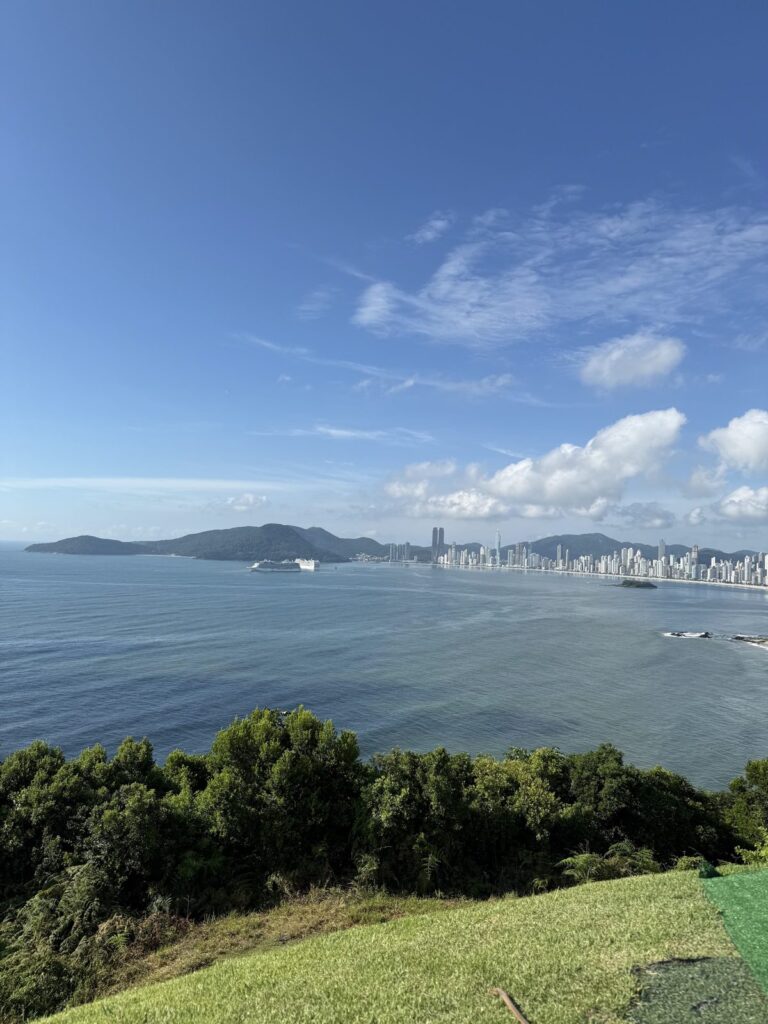
Amores is the first area north of Balneário Camboriú’s central beach. From Pontal Norte you reach it over the hill on the Estrada da Rainha, past the Big Wheel, or round by the main roads. Centro is roughly 6 km away.
Navegantes airport (NVT) is close, about 30 to 40 minutes depending on route and traffic; BC as a whole is about 35 km from the airport by road. Florianópolis airport (FLN) is about 1 hour 15 to 1 hour 30 minutes south on the BR-101. The centre of Itajaí is about 7 km away.
Avenida Rui Barbosa runs along the beach and Avenida Carlos Drummond de Andrade runs behind it. Most shops, cafés and restaurants are on these two roads.
The beach
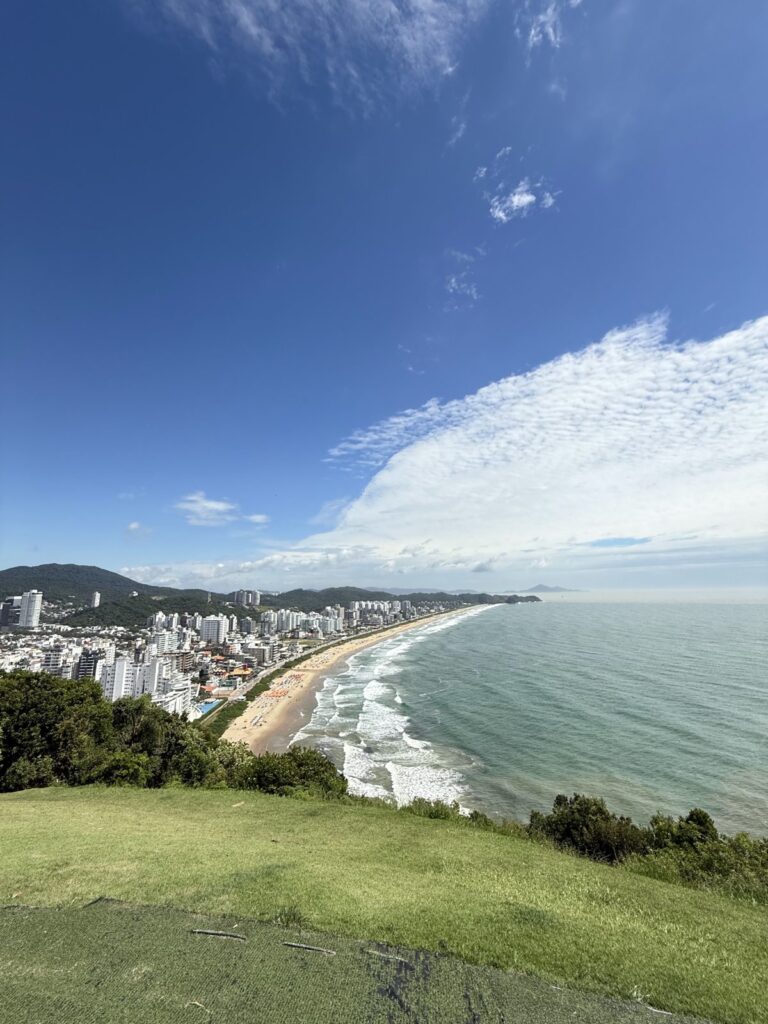
Praia dos Amores is the southern corner of the long beach that continues north as Praia Brava. The two share the same sand.
The beach is more natural than Praia Central. It is open sea, with real waves, so it is popular with surfers and kitesurfers. On rough days it is less suited to small children. Swim where there are lifeguards.
Technically the sand belongs to the municipality of Itajaí. The streets behind it, south of the small Ariribá stream, are part of Balneário Camboriú. For a buyer this matters: the municipality decides property tax (IPTU), zoning and building rules, so check which side of the line a property is on.
Water quality is tested by the state agency IMA-SC as part of its Praia Brava monitoring in Itajaí. Check the current results by beach at balneabilidade.ima.sc.gov.br.
Day-to-day life
Amores has its own small shops, bakeries, pharmacies and cafés along Rui Barbosa and Carlos Drummond. For a big supermarket shop, most residents drive to Avenida do Estado in BC (Angeloni has a store at number 2440) or into Praia Brava.
The nearest hospitals are in BC: the private Hospital Unimed Litoral on Avenida do Estado 1550, and the public Hospital Municipal Ruth Cardoso in the Bairro dos Municípios. Itajaí also has hospitals.
Bilingual schools in BC, such as Maple Bear (Bairro dos Estados) and Colégio CECS, are a short drive away.
Eating out
There are plenty of restaurants and beach clubs. One we like is Distretto Bar & Trattoria, an Italian-style bar and trattoria at Avenida Rui Barbosa 236, near the line where Amores becomes Brava.
The city tourism office also lists, among others, Amaité (Avenida Rui Barbosa 1000), Nakayoshi Sushi (Avenida Rui Barbosa 699) and Boteco da Brava (Avenida Rui Barbosa 580). You will also find burger places, cafés and simple beach bars along the same streets. Praia Brava, with its bigger beach clubs, is just up the road.
Housing
The housing stock is mostly low and mid-rise condo buildings, plus some houses and small resort-style developments. Buildings are generally newer than in Centro. Height limits are much lower than in BC’s central strip, which is a big part of the appeal.
We have not found a reliable published price per square metre for Amores on its own. For context, FipeZap put the city-wide averages in September 2026 at R$ 15,369 per m² for Balneário Camboriú and R$ 13,453 for Itajaí. Beachfront and new units in this area are usually priced well above those averages.
The seasons
In summer (December to February) the beach, the beach road and parking all get busy, and the Estrada da Rainha can back up. It still stays far calmer than Centro.
In winter it is quiet and green. Some beach businesses cut their hours, but residents’ services stay open.
Safety
We have not found neighbourhood-level crime statistics we trust. Treat the beach in summer like any busy beach: keep valuables out of sight.
Living here
Amores suits people who want a calmer beach life, with the city close when they need it.
It also suits surfers, and anyone who wants lower buildings and some green around them.
Most daily errands mean a short drive. If you want to walk to everything, Centro or Pontal Norte will suit you better.
Pros and cons
Pros: Lower buildings and more green; A real surf beach; Minutes from BC and close to NVT; Good restaurants and beach clubs.
Cons: Rough sea on many days; Most errands need a car; Split between two municipalities; Summer traffic on the Estrada da Rainha.
Buying from abroad: the basics
Foreigners can buy urban property in Brazil in their own name. You will need a CPF, the Brazilian tax number, which you can request through a Brazilian consulate before you travel.
Before signing anything, have an independent local lawyer check the property’s registration (the matrícula at the Cartório de Registro de Imóveis), any debts on it, and, for off-plan purchases, the developer’s registration of the project (the incorporação).
On purchase you pay a transfer tax (ITBI) to the municipality, here Balneário Camboriú or Itajaí, depending on the side of the line, plus notary and registry fees. After that there is an annual property tax (IPTU) and, in a condo, a monthly condo fee. Ask for the current figures for the specific property, as they vary.
Money sent from abroad should go through a bank or authorised exchange channel, and be documented, so it can be sent back later.