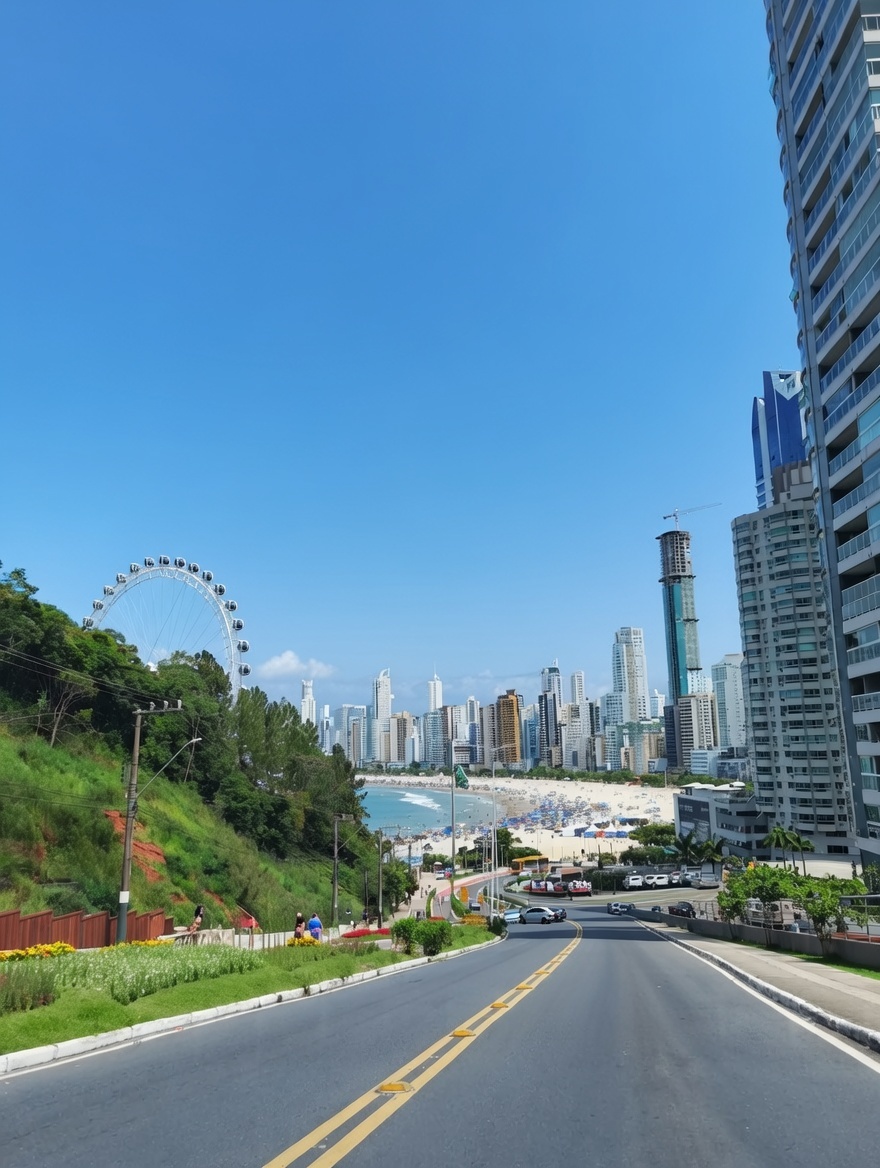
What it feels like
The Avenida Interpraias is a scenic coastal road. It starts at Barra Sul and connects a string of beaches with very low-density development.
Along the way are Laranjeiras, Taquarinhas, Taquaras, Pinho, Estaleiro and Estaleirinho. Laranjeiras can also be reached by the Unipraias cable car.
It is a different world from the towers of Praia Central: forested hills, rocky headlands and small coves, all still within the municipality of Balneário Camboriú.

Where it is and how it connects
The Interpraias road is about 12 km long. It begins at Barra Sul, winds south over the hills and along the coast, and rejoins the BR-101 at exit 136, just before the Morro do Boi tunnel towards Itapema.
That means the southern beaches are often quicker to reach from the BR-101 than through the city. Navegantes airport (NVT) is roughly 45 minutes to an hour away depending on which beach and the traffic; Florianópolis airport (FLN) is a little over an hour south.
Public transport is limited. A city bus line (02, Estaleirinho–Unimed) runs along the road, but in practice you need a car.
The beaches, one by one
Each beach has its own character. Here they are from north to south.
Laranjeiras. About 750 metres long and about 6 km from Centro. A small bay surrounded by Atlantic forest, with calm, greenish water, good for swimming and children. It is the busiest and best-served of the southern beaches, with a row of restaurants, bars and shops, and it is the arrival point of the Unipraias cable car from Barra Sul. In the IMA-SC report of 15 September 2026, its test point was rated fit for bathing.
Taquarinhas. The wildest of the beaches: coarse sand, clear but rough water, and no infrastructure at all. It is reached on foot down a trail from the road. Most people stop at the viewpoint (mirante) on the Interpraias, which has a small car park.
Taquaras. Longer, with a wider strip of sand. The water is clear and often calm on the surface but deepens quickly. There is a small settlement with guesthouses, restaurants and a fishing community. IMA-SC rated the sea point (Avenida Rodesindo Pavan 800) fit and the lagoon point unfit for bathing in its 15 September 2026 report.
Pinho. Brazil’s first official naturist beach, founded in 1984. About 500 metres long and about 13 km from Centro. Nudity is required on the sand, with a small area for non-naturists. It has a campsite, a guesthouse and a bar.
Estaleiro and Estaleirinho. The last two beaches before Itapema, with Blue Flag certification in recent seasons. They now have their own guides: see Estaleiro and Estaleirinho.
Day-to-day life
Shops are few and far between. Laranjeiras and Taquaras have small markets and restaurants, but for a supermarket, pharmacy chain or doctor you will drive into BC or to Itapema.
The nearest hospitals are in BC: the public Hospital Municipal Ruth Cardoso (Rua Angelina, Bairro dos Municípios) and the private Hospital Unimed Litoral (Avenida do Estado 1550). From the far south, Itapema is also close.
Bilingual schools such as Maple Bear and Colégio CECS are in BC, so school runs mean daily driving.
Housing
This is mostly houses, small condos and a few low-rise buildings, set into the hillsides. Plots are larger and the setting is green.
Higher-end developments are being planned here. Peace and calm will have their price.
We have not found reliable published price figures for the Interpraias beaches. The FipeZap city-wide average for Balneário Camboriú was R$ 15,369 per m² in September 2026, but that figure is driven by apartments in the central strip and says little about houses here.
Many plots are on steep land and near protected forest, so check environmental and building restrictions with a local lawyer before buying.
Getting around
The road winds over the hills. If you do not need the city every day, this can be a great countryside retreat.
Our own rough estimate is 15 to 30 minutes to the city, depending on where you live and the season. In summer, beach traffic on the Interpraias and the queue at the Morro do Boi tunnel can add a lot of time.
The seasons
In summer the beaches and the narrow road get very busy, especially on weekends. Parking at Laranjeiras and the viewpoints fills early. In winter it is very quiet, and some restaurants close or open only at weekends.
Safety
We have not found neighbourhood-level crime statistics we trust. Houses here are more spread out than in the city, so most residents rely on gated condos, alarms or monitoring.
Living here
The Interpraias suits people who want nature and quiet, and a house rather than an apartment.
You will drive for almost everything, and the road can be slow in summer.
In return you get forest, small beaches and some of the cleanest water near BC, with the city 15 to 30 minutes away.
Pros and cons
Pros: Forest, small beaches and quiet; Some of the best water test results near BC; Houses and larger plots; Close to the BR-101 at the southern end.
Cons: Car needed for almost everything; Few shops and services; Narrow, busy road in summer; Steep land and environmental restrictions.
Buying from abroad: the basics
Foreigners can buy urban property in Brazil in their own name. You will need a CPF, the Brazilian tax number, which you can request through a Brazilian consulate before you travel.
Before signing anything, have an independent local lawyer check the property’s registration (the matrícula at the Cartório de Registro de Imóveis), any debts on it, and, for off-plan purchases, the developer’s registration of the project (the incorporação).
On purchase you pay a transfer tax (ITBI) to the municipality, here Balneário Camboriú, plus notary and registry fees. After that there is an annual property tax (IPTU) and, in a condo, a monthly condo fee. Ask for the current figures for the specific property, as they vary.
Money sent from abroad should go through a bank or authorised exchange channel, and be documented, so it can be sent back later.